The friction I kept noticing
Tap to Share began while I was researching NFC refrigerator magnets for KikiMajo Studio, my creative side project. NFC was already being used to open Google Review pages, which removed the work of finding the right link.
But navigation was only one barrier. A customer still had to decide what to say, write it, find usable photos or other material, choose a platform, and spend more time after the experience had ended. I recognized that pattern in my own behaviour: I could genuinely want to support a business and still put the task off.
There was also a merchant-side problem. Social participation campaigns often depend on staff repeatedly explaining the rules, where to post, what content is available, and how to transfer images or posters. When a social campaign uses an incentive, staff may also need to manage fulfilment. That is separate from voluntary reviews and does not mean rewarding positive Google reviews.
A consumer-behaviour hypothesis
A positive experience does not automatically become public advocacy.
CURRENT FRICTION
- Positive experience
- Intent to support
- Think · write · find media · choose platform
- No action
REDUCED-FRICTION HYPOTHESIS
- Positive experience
- Prompt at the right moment
- Guided, editable content + ready media
- UGC / advocacy
Some willingness to share may already exist at the moment a customer is especially satisfied. The barrier may be effort rather than motivation. Tap to Share is a way to test that possibility without assuming it has already been proven.
The reputation problem behind the idea
I had seen the other side of this problem at BabySquare. A dissatisfied customer publicly criticized an after-sales experience even though the store had been helping with the manufacturer's warranty process. The identifying details are not part of this case; the useful lesson was the imbalance in who feels motivated to speak.
The reputation gap
Online reputation can overrepresent customers who had a reason to complain.
Dissatisfied customer
Has a reason to speak up
- More likely to post
Satisfied customer
May simply move on
- Often stays silent
Reputation resilience
A stronger base of authentic customer experiences makes a business less dependent on any single post defining its reputation.
The goal is to help real customers share real experiences, not to manufacture positive sentiment.
Preset captions
The first Framer version was intentionally simple: give customers a ready-to-use caption so they did not have to write from scratch. It made the flow faster, but introduced another problem. If customers received similar copy, their posts could begin to look coordinated rather than genuine.
What it solved
- Less writing
- Faster sharing
- Lower participation friction
What it created
- Repetitive language
- Coordinated-posting appearance
- Authenticity risk
Why I moved from preset captions to AI
The preset version made sharing easier, but the content was too predictable. Generating different captions with AI was the obvious next step. The harder problem was making those captions sound appropriate to the person, context, language, and platform rather than like variations from the same AI system.
Different wording does not automatically mean natural wording. Generic AI output can still repeat familiar structures, use broad marketing language, or sound overly polished for the platform. Tap to Share therefore uses a controlled caption-generation system rather than a simple prompt-to-caption flow.
From variation to a useful starting point
Generating different captions was easy. Getting them to sound like something different people might actually post was the harder problem.
Merchant context · campaign context · customer-selected signals · platform rules · language rules · naturalness guardrails · customer editing
Context-aware
Merchant and campaign context shape the subject.
Customer-informed
Customer choices help determine what the caption focuses on.
Platform-aware
Tone and structure adapt to the destination platform.
Language-aware
English and Chinese are written for their own context rather than mechanically translated.
Naturalness guardrails
Generation rules reduce repetitive AI patterns and generic marketing language.
Editable
The customer keeps final control.
Primary evidence
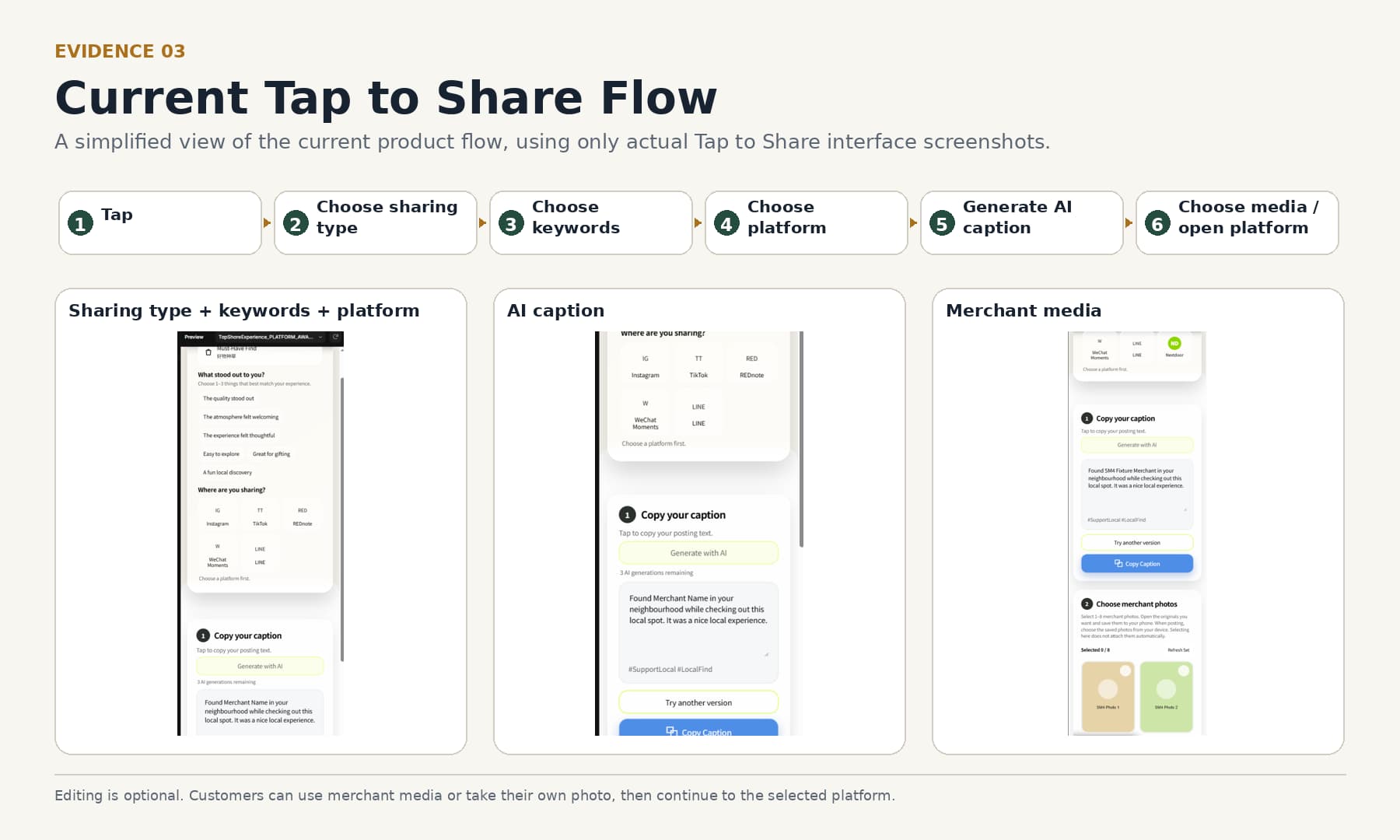
The current Tap to Share flow, from sharing choices and customer signals to an editable AI caption, optional media, and platform handoff.
A shorter path from idea to test
Before this workflow, moving an idea toward a testable product involved two kinds of cost: research friction from gathering and sorting information, and implementation friction from technical labour, handoffs, waiting, communication, and revision.
Before
Many handoffs between an idea and a test
- Idea
- Manual research and opportunity assessment
- Translate the idea into developer requirements
- Find and brief a developer
- Wait, review, explain mismatches, revise
- Repeat until testable
AI-enabled workflow
A shorter loop with judgment in the middle
- Idea
- AI-assisted market & keyword research
- Judgment — is this worth testing?
- Define the MVP
- Build with Codex
- Test ↔ refine
The research step includes structured market exploration, query and keyword discovery, search-intent analysis, and API-based research tools such as Monid. Those tools help me explore the category and its language; they do not make the product decision. Judgment stays in the middle of the workflow.
I own the research direction, product decisions, MVP scope, requirements, AI behavior and rules, QA, and iteration. AI helps with research, analysis, and structuring specifications, while Codex handles the coding implementation. That lets me move through build, test, and refinement with fewer external handoffs.
AI also changed the economics of experimentation. Work that would previously have required external development time, communication, and repeated revisions became something I could test independently before committing more resources.
From a sharing page to a product system
As the product evolved, I started thinking beyond the caption itself. Merchants needed ways to guide what customers could share. I also planned how interaction data might support later marketing decisions. The flow below includes that future measurement layer: PostHog collection is not enabled, and the merchant dashboard is not live.
Merchant-guided UGC
The merchant shapes the environment. The customer keeps control of the final content.
Campaign context, keywords, hashtags, media, platforms, and participation instructions can guide the experience without writing a fake customer post.
- Merchant setupCampaign context
Keywords
Media
Platforms - Customer experienceTap / scan
Understand
Choose
Generate / edit
Use media
Open platform / share - UGC / participationCustomer decides
what to use
what to edit
whether to publish - Planned behavioral signalsKeyword choices
Media use
Platform clicks
Generation / copy / download
Touchpoint activity - Potential merchant learningContent
Creative
Channel
Activation signals
This self-service flow may reduce some repeated explanation and content handoff for staff, although it does not remove every operational task. The planned value may extend beyond the resulting posts: future observations could show what customers select, which media they use, which platforms they open, and which touchpoints generate activity. Those are measurement questions, not current merchant reports.
From product to growth
Built / in place
- Product foundation under paid-pilot testing
- Merchant and campaign configuration
- Shared Media
- Live marketing website
Now building / testing
- Product iteration and pilot feedback
- SEO/GEO content and keyword research
- Organic acquisition and conversion hypotheses
- Measurement plan — PostHog collection not enabled
- Merchant dashboard — not live
Planned observation → marketing judgment
Future customer behavior signals could inform the next marketing decision.
Future testing framework
- Keyword selection
- What it may inform: Content / positioning signal
- Media selection / use
- What it may inform: Creative signal
- Platform choice
- What it may inform: Channel signal
- Touchpoint participation
- What it may inform: Activation signal
The growth system is now being built around the product. The sequence is observation, potential signal, marketing interpretation, then decision—not preference inferred from a single action. SEO/GEO, acquisition, and conversion performance will be evaluated once there is enough live data to measure it.