Learning the market from the front desk
I entered the education industry through a front-desk role, without a background in teaching or education. What I did bring was experience in marketing and customer-facing work, plus a habit of learning unfamiliar subjects quickly.
The front desk gave me unusually direct access to the market. Parents and students brought questions about BC curriculum, English-language learning, assessments, admissions, competitions, course selection, and school expectations. Each unfamiliar question showed me exactly where my knowledge was thin.
I started treating those questions as a learning queue. AI helped me find and compare information much faster, but speed only mattered if the information was reliable. I checked terminology and claims against curriculum documents, assessment information, credible sources, and academic input when it was relevant. Then I had to turn the research into an explanation a family could actually use.
- Parent or student question
- What don't I understand yet?
- Research with AI
- Check credible sources
- Compare with curriculum, assessment, or academic input
- Explain what I found
- Learn from the next conversation
As the consultations became more detailed, parents occasionally assumed I had studied education or psychology. I hadn't; much of what I knew came from repeatedly researching the questions families brought me, checking what I found, and seeing whether the explanation still held up in the next conversation.
Turning customer insight into content and positioning
When I began working on Xiaohongshu, I took responsibility for much of the day-to-day topic selection, copy, creative, and publishing. With limited paid-media resources, the channel depended heavily on finding subjects families actually wanted to read about. Platform compliance also became part of the workflow.
I gradually moved beyond course-led posts. The questions I heard from families gave me a wider set of topics: education explanations, Greater Vancouver school-district profiles, student volunteer opportunities, and practical information families could return to before they were ready to enroll.
Earlier emphasis
- Course information
- Enrollment messages
- Course-led publishing
Broader content mix
- Education explanations
- School-district profiles
- Volunteer opportunities
- Common parent and student questions
- Course information when relevant
Xiaohongshu became an important active acquisition channel. Useful information gave families a reason to follow, return, and begin a conversation without requiring every post to ask for a sale.
As the program mix became more specialized, I also started thinking about what the marketing should signal about the company. Content, course positioning, and consultation needed to tell a consistent story: families were not only choosing tutoring hours; they were also choosing academic guidance, program fit, and confidence in the recommendation.
- Programs
- More specialized academic offers.
- Content
- Useful education information beyond course ads.
- Consultation
- More detailed explanations of why a recommendation made sense.
- Competitions
- Academic visibility and repeated family contact.
Together, these touchpoints contributed to a more clearly academic market position.
After early parent consultations I handled led to enrollments, my responsibilities expanded to include education consulting and enrollment alongside marketing. That combination showed me both what attracted a lead and what the family needed to understand before making a decision.
The problem was not always what it first sounded like
The first description from a parent was useful, but it was not always specific enough to guide a recommendation. I learned to keep asking what the student was trying to do, where the difficulty appeared, and what kind of barrier might sit underneath the surface description.
What the family asks for
- English improvement
- Help with Science in English
What I need to understand
- Is the difficulty conversational English, academic language, subject vocabulary, or missing curriculum context?
- Is the barrier the concept itself, the instructions, scientific vocabulary, graph and data language, or written reporting?
English was often more than one problem
In repeated conversations, “English” could refer to very different barriers. A student might communicate comfortably in everyday situations and still struggle with academic instructions, subject-specific vocabulary, short written responses, graph and data interpretation, or scientific reports. The underlying concept could already make sense while the language required to work with it remained unfamiliar.
ELL Science Bridge insight
Conversational English did not always provide enough access to the academic language used in school Science.
That distinction connected a recurring frontline need to curriculum research and program development.
Turning recurring questions into programs
From recurring need to program idea
Some questions appeared often enough that they stopped looking like one-family problems. The recurring gap between everyday English and the academic language used in school Science became an input for the ELL Science Bridge Course.
- Frontline academic-language need
- BC Science curriculum research
- ELL-oriented language mapping
- Initial Bridge Course architecture
- Teacher additions and organizational approval
Program development evidence
I compiled BC curriculum sources, mapped the academic-language demands, identified and structured the Bridge Course concept, and created the initial program architecture and development content represented below. Teachers later added detailed instructional material and handled classroom delivery. Final ownership and approval remained with the organization.
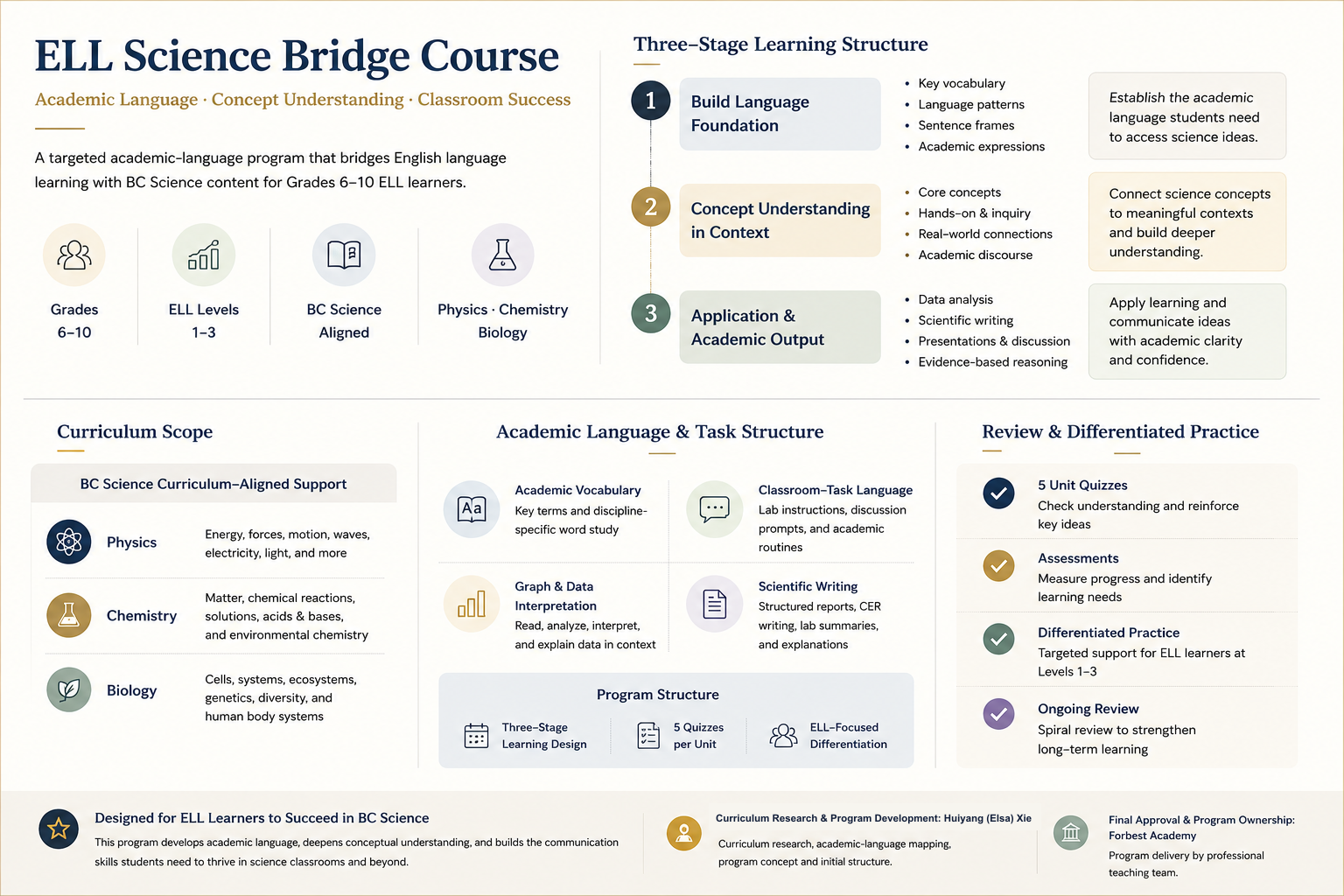
ELL Science Bridge Course — Program Development
A concise view of the course structure, learner scope, academic-language supports, and review approach.
Project figure
An overview of the ELL Science Bridge Course structure and academic-language design.
- Learners
- Grades 6–10 · ELL Levels 1–3
- Alignment
- BC Science curriculum
- Subject language
- Physics · Chemistry · Biology
- Course structure
- Three stages · quizzes and assessment · differentiated practice
- Academic vocabulary
- Subject-specific words and language patterns.
- Classroom-task language
- Language used to follow and complete Science tasks.
- Graphs and data
- Language for reading and explaining visual information.
- Scientific writing
- Support for structured reports and written explanations.
Attribution: I completed the curriculum research, academic-language mapping, Bridge Course concept, initial program architecture, and the program-development content represented here. Teachers later added instructional detail and delivered the course; final approval remained with the organization.
From curriculum research to design
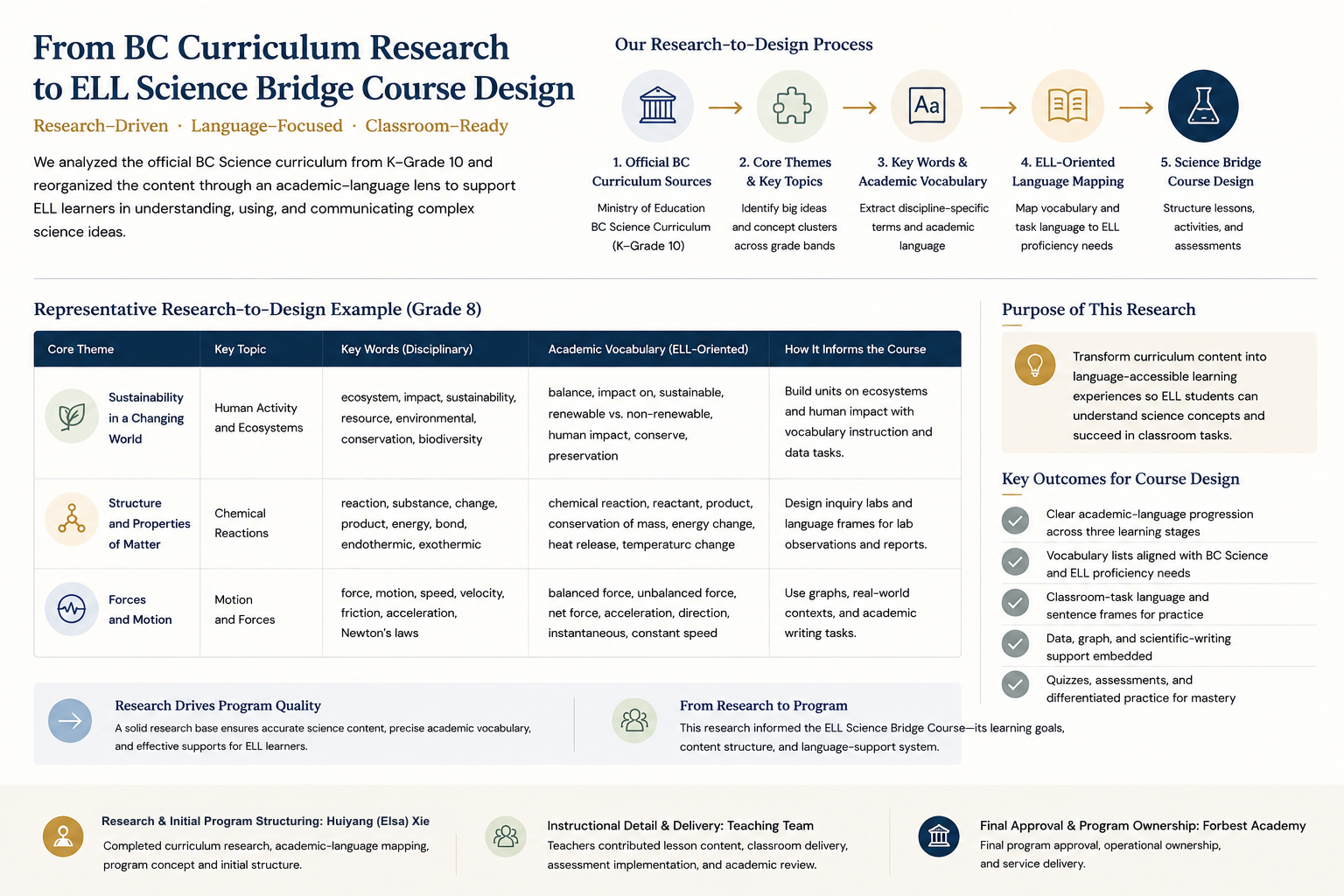
Curriculum Research → Program Design
A representative abstraction of the K–Grade 10 research structure, rather than a copy or download of the full internal artifact.
Project figure
How BC Science curriculum research informed the ELL Science Bridge Course design.
- Official BC curriculum sources
- Core themes and key topics
- Key words and academic vocabulary
- ELL-oriented course structure
Representative mapping
A Science topic was traced from its official curriculum source to the core concept and academic vocabulary, then mapped to the language students needed for classroom tasks, graphs and data, and scientific writing.
This structure connected curriculum research to the initial Bridge Course design without publishing the underlying research file.
Only the research method and a bounded representative mapping are shown. Full curriculum compilations and teacher-owned instructional detail remain private.
Demand cycles and the customer journey
Education demand did not move on one timeline. Some services were immediate and deadline-driven. Others developed over a longer period and required more planning and accumulated trust before a family was ready to commit.
Demand horizons
Customer journey
Competition as an earlier touchpoint
At earlier or lower difficulty levels, some parents could support competition preparation themselves. As the difficulty increased, outside instruction could become more valuable. First contact and course demand did not always happen at the same time, so competition participation could appear earlier in the customer lifecycle.
Working across marketing and enrollment expanded my view of the customer journey. Acquisition could bring a family in, but the relationship depended on what happened next and whether the experience matched the expectations set before enrollment.
- DiscoverContent / acquisition
- UnderstandExpectations / consultation
- ChooseProgram fit
- ExperienceService experience
- ContinueRetention / next need
More leads were not automatically better leads. I became more interested in why a family chose a program, whether the offer matched the student's actual need, and what would make the relationship continue after the first enrollment.
Traffic also could not be evaluated in isolation. Attention moved through content, the website, or another information touchpoint before reaching consultation and conversion. I started thinking more carefully about how those parts connected.
From acquisition to relationship
If I only look at acquisition
- How do we get more attention?
- How do we generate more inquiries?
- Which touchpoint brought the lead?
If I look at the journey
- Why did the family respond?
- What do they expect?
- Does the program fit the need?
- What would make them stay?
The longer and more comprehensive the service became, the more important trust and perceived expertise were to the decision. The relationship could shift from choosing one course toward coordinating support across a longer period.
Programs, content, and consultation all helped establish expectations before conversion. For a longer, higher-commitment service, the company's academic positioning became part of how a family understood the offer and decided whether to continue the relationship.
Acquisition starts the relationship. Long-term value depends on what happens after the first conversion. Clear expectations, appropriate program fit, and a useful experience all shape whether the relationship continues.
What this changed about how I work in marketing
This experience changed how I approach an unfamiliar market. I don't need to know everything before I start, but I do need a reliable way to identify what I don't know, research it, check it against credible sources, and keep refining my understanding through real customer conversations.
I also became more comfortable treating marketing, consultation, and program development as connected work. A recommendation was easier for a family to evaluate when I could explain the reasoning behind it. Repeated questions could point to a program opportunity, while useful content could help families understand a decision before they were ready to enroll.
AI made that process much faster. What mattered more was knowing what to investigate, checking what I found, and deciding how much confidence to place in it before using it in a recommendation or piece of work. That process made it easier to enter unfamiliar domains without treating AI output as an answer by default.